

She Did Not Bow
Agrippina the Elder and What Power Cannot Forgive

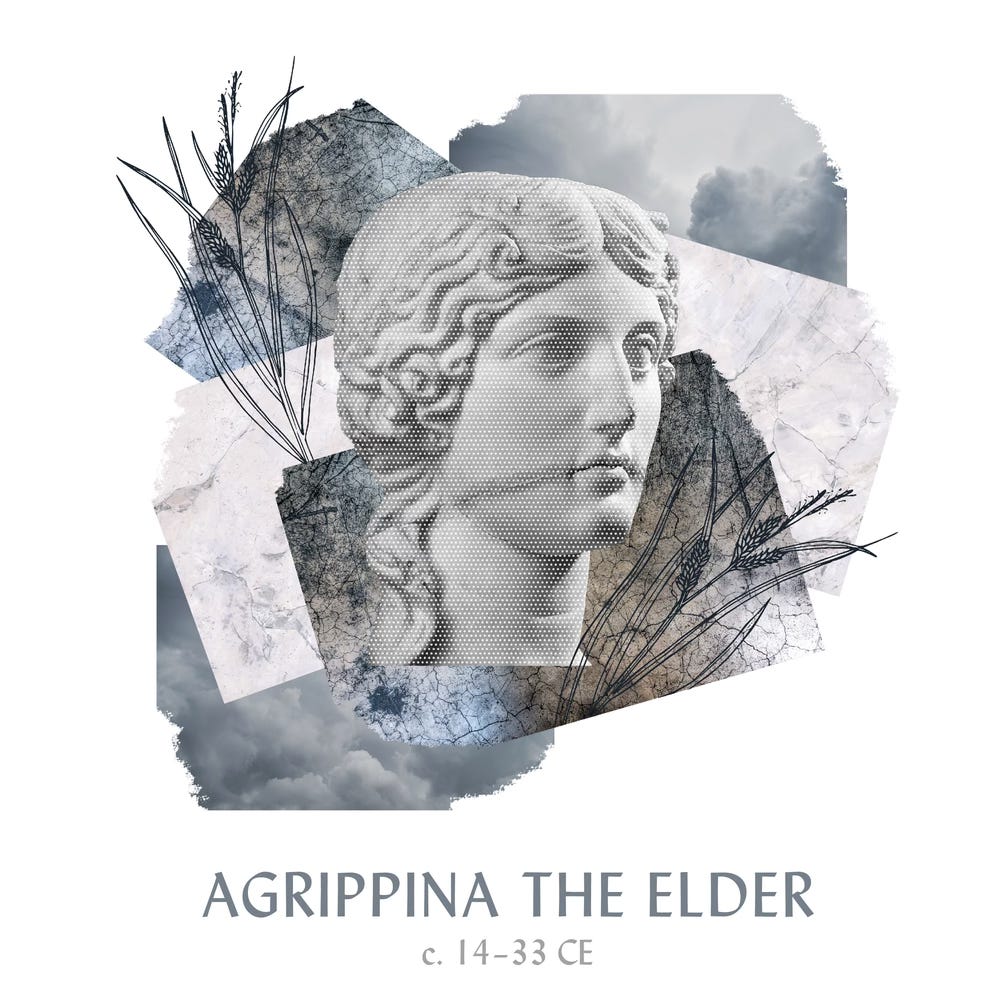
There is a particular kind of threat that power finds unbearable. Not the sword raised against it. Not the conspiracy whispered in corners. Those, power knows how to answer. What power cannot tolerate… what makes emperors lose sleep and invent charges and eventually reach for exile and starvation as their only remaining tools, is the person who simply will not perform submission.
Agrippina the Elder did not perform submission.
She lived in Rome at the height of its imperial confidence, in the first century of the common era, when the machinery of the Julio-Claudian dynasty was still warm with the ambitions of Augustus. She was granddaughter to that Augustus, wife to the most beloved general Rome had seen in a generation, mother to nine children, and the woman whom the Roman people called; in the words Tacitus preserved, “the glory of the country, the sole surviving offspring of Augustus, the solitary example of the good old times.”
She was also the woman a sitting emperor destroyed slowly, over years, with the patience of someone who knew he could not be seen to hurry.
The Blood She Carried
She was born around 14 BCE into a family so entangled with power that there was no separating her biography from Roman history. Her father was Marcus Agrippa: the general and architect who built the Pantheon, who won the Battle of Actium for Augustus, who was essentially the military arm that held the whole Augustan project together. Her mother was Julia the Elder, Augustus’s only biological child, a woman of formidable intelligence and reportedly formidable appetites, who would herself end her life in exile, slowly starved on an island by her father’s order.
There is something to pause over in that lineage. Agrippina was born to a woman who died in imperial exile, and she would die in imperial exile herself. The pattern suggests not a family curse but a recurring structural truth: in the Julio-Claudian world, the women who carried too much public weight; too much love from the people, too much symbolic legitimacy… eventually became intolerable. They had to be removed. The empire needed them to be decorative. When they refused, there was only one direction left to send them.
Agrippina survived childhood watching her immediate family dissolve. Her brothers Gaius and Lucius died young. Her brother Agrippa Postumus was exiled for unruly behavior, then killed. Her mother died on Pandateria, the island of women the dynasty didn’t know what else to do with. By the time Agrippina was in her mid-twenties, she was, as one historian notes, the only member of her immediate family not dead or rotting in exile.
That survival shaped everything that came after. She was not naive about what the system was capable of. She had seen it at work on people she loved. And she refused to moderate herself anyway. That is the first thing to understand about her: her stubbornness was not ignorance. It was refusal.
The Marriage That Was Also a Partnership
In 5 CE, she married Germanicus Julius Caesar. By all accounts; and the ancient sources are unusually consistent on this point, it was a genuine partnership. Not the ornamental arrangement most aristocratic marriages were. Agrippina accompanied Germanicus everywhere he went, across campaigns and provinces and the rough edges of empire, bringing their children with her into conditions that no Roman convention required her to endure.
When Germanicus took command of the Rhine legions in 14 CE, she was there. When Augustus died that same year and the legions mutinied, demanding better terms of service, she was in the camp. She was pregnant. She was also, by all accounts, present and functional in ways that mattered. Tacitus records that during the chaos of the mutiny, it was suggested to the soldiers that Agrippina: a woman, a pregnant woman, was preparing to flee with her children to safety among foreign people, because they posed a greater danger to her than the Germans across the Rhine. The soldiers’ resolve broke. Reconciliation became possible.
She had not given a speech. She had not fought. She had simply been there, visibly herself, in conditions that exposed the soldiers’ threat for what it was.
The following year, when a Roman fleet returned from a difficult German campaign battered and demoralized, Agrippina stood at the bridge over the Rhine and stopped the panicked soldiers from destroying it. She met the returning men there, personally, and according to Tacitus thanked them for their service. Tiberius, already watching her, took note. A general’s wife who could stabilize legions was not a wife. She was a rival.
She did not see it that way. Or perhaps she saw it clearly and refused the performance of smallness it would have required to make Tiberius comfortable.
What Happened in Antioch
In 19 CE, Germanicus died in Antioch. He was thirty-three years old. The cause was debated then and remains debated now; sudden illness, or poison, or the long-running political enmity of Gnaeus Calpurnius Piso, the governor of Syria, whose relationship with Germanicus had broken down in ways that were never cleanly resolved. Agrippina believed he had been murdered. She believed Tiberius was involved. She said so.
That accusation; spoken by a woman, in public, against an emperor, was not forgotten.
What she did next became one of the defining images of her life, and of the ancient world’s understanding of grief as political act. She had Germanicus cremated in the forum at Antioch. She took the urn containing his ashes into her own hands. And she carried him home.
The journey from Syria to Rome was not a private one. At every port, at every town, people came out. When her ship was spotted off Brundisium, crowds had already gathered at the harbor, on the walls, on rooftops. Tacitus writes that her companions were worn out by prolonged grieving, so that the sorrow of the fresh mourners who now met her was, by contrast, more demonstrative. Veterans wept. Strangers wept. The whole country, it seemed, was waiting for her to arrive, because watching her arrive was a way of saying something that could not otherwise be said: that Rome had lost what it most valued, and that the man who still sat on the throne was not it.
She walked through Rome with the urn in her arms and her children around her, in silence, to the Mausoleum of Augustus. And then she placed her husband there.
Tiberius was furious. He could not publicly punish her for a funeral. But he understood what it had meant. The procession was a verdict. The silence of the crowd was louder than any accusation. And Agrippina had staged it without a weapon, without a political alliance, without anything except the fact of her grief and the people’s love and her own refusal to grieve quietly at home.
The Long War
The years between 19 CE and 29 CE were a slow, grinding campaign of mutual hostility. Tiberius withdrew increasingly into suspicion and then, in 26 CE, into literal withdrawal, retreating to the island of Capri and leaving Rome in the hands of Sejanus, his Praetorian prefect: a man whose primary interest was eliminating anyone who stood between himself and the succession he imagined for himself.
Agrippina gave neither of them the performance of deference they required.
Suetonius records a dinner at which Tiberius offered her an apple. She would not eat it… she feared it was poisoned. The story may be apocryphal, but Tiberius, whether it happened or not, reported it to the Senate as proof of her accusation against him. The Senate, under the conditions of Tiberian Rome, accepted this framing. She had charged him with attempted poisoning, the emperor said, by refusing fruit. That a woman’s self-preservation could be reframed as an attack on an emperor tells you everything about the architecture of the accusation system that eventually consumed her and her sons.
Tacitus describes her in these years as proud, inflexible, increasingly confrontational. He uses these as criticisms. But read from outside the Roman social contract he inhabited, they describe something else: a woman who refused to become smaller to save herself, who continued to say what she believed to be true even when the cost of saying it was clearly escalating, who would not flatter a man she considered complicit in her husband’s death.
Her sons Nero Julius Caesar and Drusus Julius Caesar were the visible targets. Sejanus had them accused, exiled, killed. Agrippina, after her protector Livia Drusilla died in 29 CE, was herself arrested and exiled to Pandateria; the same island where her mother Julia had been sent decades before.
The repetition is not coincidence. It is procedure.
The Island
On Pandateria, she went on hunger strike.
Her captors force-fed her. On one occasion, a centurion beat her so badly she lost an eye. She continued to refuse.
Whether her eventual death in 33 CE was the result of her own starvation or deliberate deprivation ordered by Tiberius is, as the ancient sources acknowledge, unclear. Tacitus suggests her food was withheld to disguise her execution as suicide. The ambiguity itself is a form of evidence: an emperor who had to obscure the manner of a woman’s death in an account written within living memory of the event was an emperor who knew what he had done was unjustifiable.
She had outlived two of her sons. She died not knowing whether Caligula, the youngest, the one who had grown up in the camps, the one the soldiers had called Little Boots for the miniature legionary sandals he wore as a toddler, would survive.
He did. He became emperor. One of his first acts was to honor his mother’s memory, to sail to Pandateria himself and bring her ashes back to Rome, to place them in the Mausoleum of Augustus beside the husband she had carried home from Antioch.
In death, she got the procession twice.
What She Reveals
Here is the question that Agrippina’s life insists on, if we are honest: what was Tiberius actually afraid of?
Not her sword arm. She had none. Not her political alliances… she was systematically stripped of those. Not her wealth, not her formal power, not any office she held, because Rome gave women no offices to hold. By every metric the Roman system recognized, she had no power. She was an aristocrat, a widow, a mother. The categories available to her were ornamental.
And yet Tiberius spent years engineering her destruction. Sejanus dedicated resources to her removal that might otherwise have gone to actual political threats. Two emperors: Tiberius through his neglect of her sons, and the whole system through its treatment of her, moved with the slow efficiency of people managing something genuinely dangerous.
What they were managing was her refusal to reflect their legitimacy back at them.
This is what power requires that we rarely name directly: it requires the consent of the governed not just in policy but in performance. The powerful need to be seen as legitimate. They need the people around them; especially the people whose proximity grants reflected authority, to behave as though the current arrangement is natural, correct, and inevitable. When someone near the center refuses that performance, they do not merely dissent. They make the performance visible as performance. And that is unbearable, because the moment power is seen as power; as constructed, as contingent, as dependent on consent… it has already lost something it cannot get back.
Agrippina’s presence in Rome, with the people’s love and Germanicus’s memory behind her, was a standing demonstration that Tiberius’s legitimacy was not self-evident. She did not have to say it. She simply had to exist, visibly, unflattered, unsupressed. Every day she did not bow was an argument.
This is what every authoritarian system has always known about nonconformity: that it is more threatening than opposition, because opposition can be defeated, while refusal simply continues. You can beat an enemy. You cannot beat a woman who looks through you.
The Mirror
She is also a mirror in the sense that she reflects back the question of what we mean when we say a woman should be “appropriate,” “measured,” “diplomatic,” “careful.” The Roman sources that preserved her story; Tacitus, Suetonius, the others… were men writing within the very system that destroyed her. And even they could not quite bring themselves to say she was wrong. They called her proud. Inflexible. Difficult. They noted her insubordination. And then they preserved, in extraordinary detail, the evidence that the people loved her, that the soldiers trusted her, that her grief was more politically coherent than Tiberius’s caution, that her sons were widely seen as legitimate heirs.
The condemnation and the evidence do not cohere. They wrote the criticism and then forgot to remove the testimony. And what the testimony shows is a woman who read her situation correctly, who identified the threat accurately, who behaved with absolute consistency from her husband’s death to her own, and who was destroyed not for being wrong but for being unmovable.
Power cannot work with the unmovable. It can only remove them. And then, sometimes, a generation later, return their ashes with state honors and pretend the removal was a regrettable misunderstanding.
Caligula became a monster, as history knows. He was also the child who grew up watching his mother refuse. He honored his mother through the procession and the Mausoleum. He brought her home.
She did not live to see either the monster or the homecoming.
She died on an island, having refused food in a body that had already lost an eye, having outlived the sons she had carried through military campaigns and tried to protect through a decade of political war. The empire could exile her, beat her, starve her. It could not make her smaller than she was.
That is not a consolation. It is simply the fact of her.
Sources: Tacitus, Annals (Books I–VI); Suetonius, Lives of the Twelve Caesars; Annelise Freisenbruch, The First Ladies of Rome; Anthony A. Barrett, Agrippina: Sex, Power, and Politics in the Early Empire.
A great example of power play and how even from early times, women were feared for their inherent power, it wasn’t overt, but it was palpable. Amazing writing Sara.
Sara, this is one of the most inspiring essays I have read in a very long time. Incredibly well written.
Monica